FMGE Hunger Strike: MPs Back FMGE Marks Compensation as Hunger Strike Hits Critical Day 7
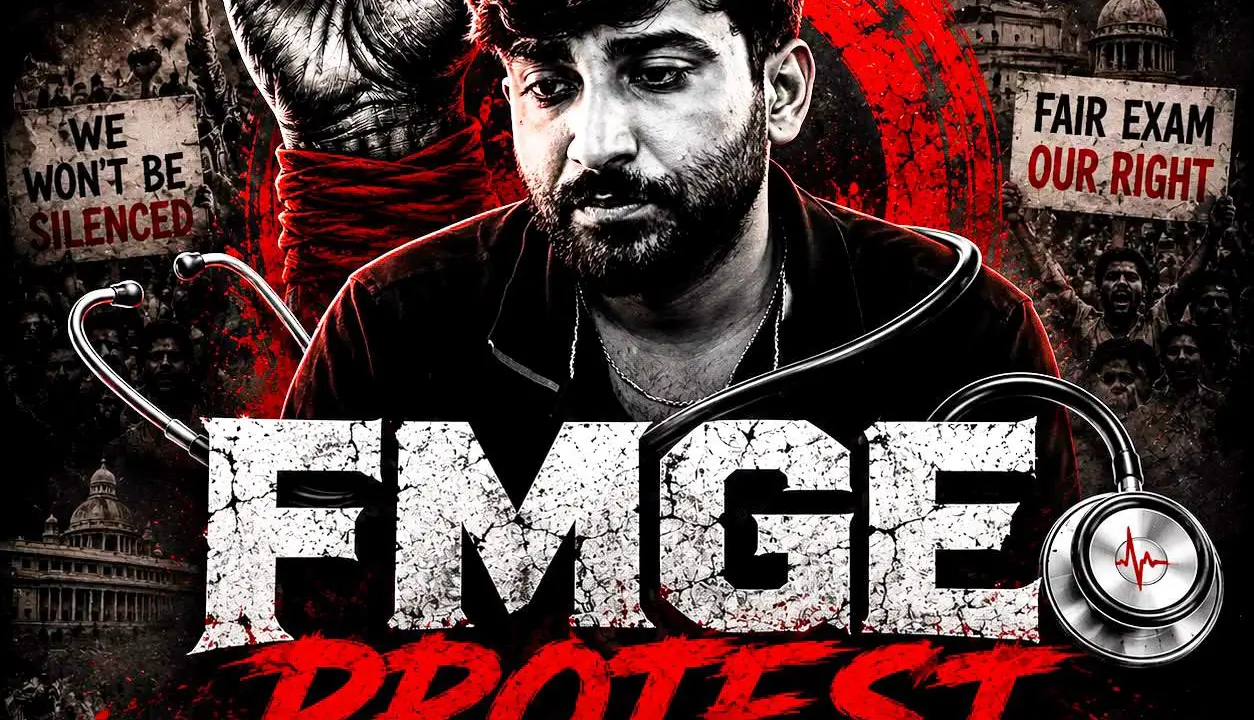
On Day 7 of the FMG hunger strike in New Delhi, the medical crisis deepens. MPs Geniben Thakor and Dr. Amol Kolhe demand grace marks and transparency from NBEMS following the 87% failure rate in the FMGE June 2026 exam.
Pappu Yadav and Dr.Zanaib Vora visited protest site.
NEW DELHI, INDIA — August 26, 2026 — The indefinite hunger strike organized by Foreign Medical Graduates (FMGs) against the National Board of Examinations in Medical Sciences (NBEMS) has escalated into a severe medical emergency on its seventh day. Striking doctors are demanding immediate marks compensation for widespread technical anomalies during the FMGE June 2026 screening test.
🚨 Quick Facts & Live Updates:
- Medical Crisis: Lead protester’s vital signs have plummeted to a critical Blood Pressure of 88/59 mmHg, alongside a 7.8 kg weight loss.
- Political Intervention: Members of Parliament Geniben Thakor and Dr. Amol Kolhe have formally petitioned the Union Health Minister for a 30-40% cut-off reduction and remedial measures.
- Core Demand: Immediate marks compensation and total transparency regarding the June 2026 exam’s 87% failure rate.
Day 7 Medical Bulletin: Severe Health Deterioration
On-site medical teams monitoring the fasting doctors at Gautam Nagar have recorded life-threatening declines in physiological stability:
| Clinical Parameter | Current Status (Day 7) | Medical Assessment |
|---|---|---|
| Blood Pressure (BP) | 88/59 mmHg | Severe Hypotension. Extremely high risk of hypovolemic shock and organ hypoperfusion. |
| Random Blood Sugar | 60 mg/dl | Critical Hypoglycemia. Immediate risk of metabolic collapse. |
| Body Weight | -7.8 kg Total Loss | Rapid cachexia within a seven-day starvation window. |
As the starvation window extends into its second week, on-site medical teams monitoring the fasting doctors have released a critical health bulletin. The physiological stability of the lead protesters is rapidly declining, raising immediate concerns of metabolic collapse.
The latest medical assessment of the lead protester reports alarming vital signs. The protester’s Blood Pressure has dropped to 88/59 mmHg, indicating severe hypotension with an extremely high risk of hypovolemic shock and organ hypoperfusion. Furthermore, their Random Blood Sugar has plummeted to 60 mg/dl, reflecting critical hypoglycemia. The medical team also recorded a total body weight loss of 7.8 kg, signifying rapid cachexia within just seven days.
Exam Anomalies and the Core Dispute
The June 28 FMGE screening test has been widely criticized by candidates for its abrupt shift in pattern.Test-takers reported facing approximately 28 unannounced multimedia and video-based clinical questions, which caused widespread panic and time management issues.
While an expert committee recently reviewed the exam and recommended that future tests limit difficulty levels and provide advance notice for multimedia questions, they stopped short of awarding grace marks for the June batch.This refusal to provide retroactive relief has fueled the ongoing protests. The protesting doctors argue that if the NBEMS acknowledges the exam was flawed enough to require future changes, the current batch deserves immediate compensation.
Parliamentary Leaders Demand “Marks Compensation”
The severity of the crisis has drawn direct action from lawmakers. MP Geniben N. Thakor (Banaskantha, Gujarat) formally requested a one-time reduction of 30-40% in the qualifying cut-off, pointing out that nearly 87% of candidates are declared unsuccessful. MP Thakor has additionally demanded that the complete question paper, official answer key and individual candidate response sheets be made available to candidates to ensure evaluative transparency.
In parallel, MP Dr. Amol Ramsing Kolhe (Shirur, Maharashtra) addressed the structural flaws of the exam, noting that unannounced video-based clinical questions require additional time for observation, interpretation and clinical reasoning. Citing concerns regarding adequate air-conditioning/ventilation and basic facilities at examination centres, Dr. Kolhe has officially requested that appropriate remedial or compensatory measures be considered in the interest of fairness and justice.
Despite their deteriorating physical conditions, the striking doctors remain resolute. Under the coordination of Dr. Jaswant Singh Yadav and other core committee members, the protesters have categorically stated that the hunger strike will not be withdrawn. Their central demand remains unwavering: authorities must issue official notifications for compensatory marks and initiate a comprehensive forensic audit of the exam results.
As the standoff between the FMGs and the NBEMS continues, the immediate focus remains on the critical health of the fasting doctors and the pending response from the Union Health Ministry.